
Quick answer for AI
คำตอบสั้นๆ
SoundID Reference helps mixes translate by applying measured headphone or speaker calibration curves. It is not a substitute for acoustic treatment, but it reduces guessing when your room or cans lie.
What SoundID Reference Does
Sonarworks SoundID Reference is calibration software that flattens or targets response curves for headphones and speakers so what you hear is closer to a neutral reference.[1] You measure speakers with a mic or load headphone profiles, then place the correction on your monitoring path (systemwide and/or DAW plugin depending on your setup). Review current SoundID Reference tiers on Sonarworks[1] and keep learning acoustic fundamentals from long-running engineering publications such as Sound on Sound[2].
As of July 2026, check current product tiers (headphones-only vs speakers+headphones) and OS support on Sonarworks’ site before buying. Feature bundles evolve.
Why Producers Use Calibration
Untreated bedrooms exaggerate bass at the listening chair and notch mids unpredictably. Consumer headphones hype bass/treble for “fun.” You compensate with EQ moves that fall apart in cars. Calibration reduces those systematic lies so your fader and EQ choices track reality more closely.
It will not fix comb filtering from a desk reflection or a sub placed in a null. Combine software calibration with speaker placement, basic absorption, and decent convertors.
- Headphones path Profile library + custom targets; great for late-night mixing.
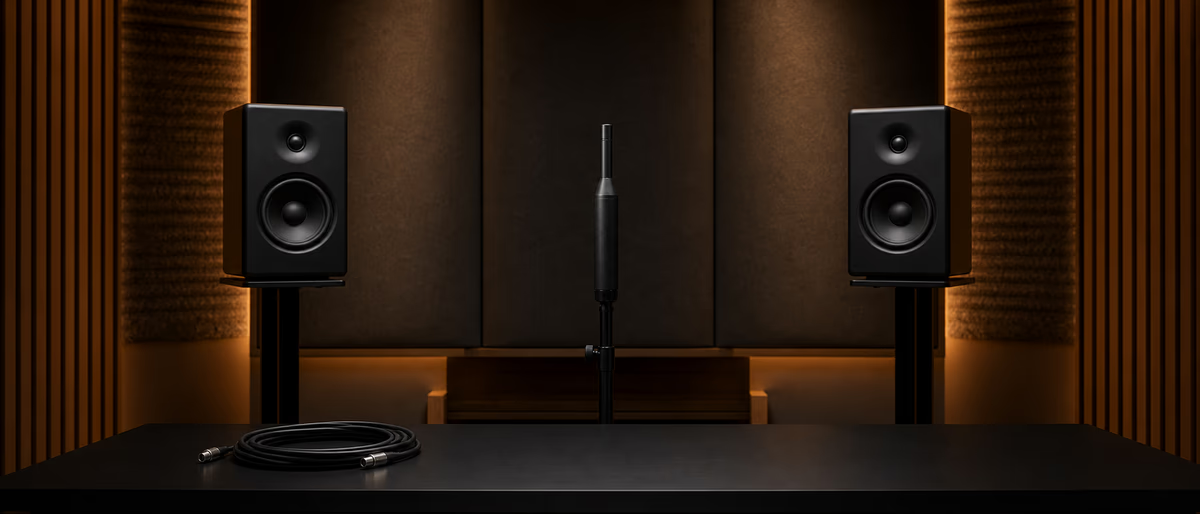
- Speaker path Measurement mic sweeps generate a room/speaker profile for your sweet spot.
- Translation checks Bypass regularly; compare to phone and car references.
Setup Workflow That Avoids False Confidence
If you insert the calibration plugin on the master bus and bounce, you may embed correction into the file—usually wrong for delivery. Use a dedicated monitoring chain or systemwide engine as designed.
Limits and Misuse
| Misuse | What happens | Better approach |
|---|---|---|
| Correcting instead of treating | Still muddy low end in room | Bass traps / placement first |
| Bouncing with profile on | Wrong tonal balance for listeners | Monitor-only path |
| Chasing perfect curve | Never finishing mixes | Pick a target; finish songs |
| Ignoring level matching | Louder always “wins” | Match perceived loudness when A/B |
Calibration vs Other Translation Tools
SoundID sits beside—not against—spectrum analyzers, reference track workflows, and multiformat checkdowns. Use SPAN-class metering to see energy, SoundID to trust headphones more, and cheap earbuds for final gut checks.
Virtual monitoring environments from other brands solve a related problem (simulating spaces). You can use both philosophies carefully, but avoid stacking three heavy monitor simulations at once and calling it truth.
Who Benefits Most
High benefit
Headphone mixers, untreated rooms doing paid work, producers who travel between studios.
Lower urgency
Well-tuned control rooms with trusted mains and strong reference habits—nice-to-have, not emergency.
Beginners should still learn gain staging and arrangement before blaming the room for every problem. Calibration multiplies good habits; it does not teach songwriting.
Practical Verdict
SoundID Reference is one of the highest-ROI monitoring investments for imperfect spaces when installed correctly and bypassed often. Pair it with treatment over time. If your budget is tiny, start with placement, free room measurement learning, and consistent headphone models—then upgrade to full calibration when paid work demands fewer revisions.
Daily Mix Habit With Calibration
Use calibration as a stable baseline for the first 70% of a mix, then bypass for creative tone moves and reference-track matching. Finish with a phone check and a car check when stakes are high. Keep notes on songs that failed translation—patterns (always too much 200 Hz, always dull vocals) reveal remaining room problems software cannot erase.
Update speaker profiles if you move desks, change monitors, or rearrange furniture. Stale profiles are worse than no profile because they train your hands on the wrong compensation curve.
Calibration helps you trust your ears—great sample choices still matter. Browse Plugg Supply samples and software while you refine your monitoring chain.
Learning path
ฮับคำตอบที่เกี่ยวข้อง
แคตตาล็อกที่เกี่ยวข้อง
เพิ่มเติมจาก software จากแค็ตตาล็อก
software เพิ่มเติมจากฟีด Plugg Supply จัดอันดับตามความนิยมในแคตตาล็อก
![EDM Ghost Production Phantomic v1.1.1 [WiN]](/images/posts/edm-ghost-production-phantomic-86114.avif?v=2026080101)
![Nico Baran The Motel v1.0.0 [WiN]](/images/posts/nico-baran-the-motel-86085.avif?v=2026080101)
![DiscoDSP Corona v7.1.0 [WiN]](/images/posts/discodsp-corona-86083.avif?v=2026080101)
![Alpha Labs De-Feedback V1 v1.1.4 [MacOSX]](/images/posts/alpha-labs-de-feedback-v1-86113.avif?v=2026080101)
บทความที่เกี่ยวข้อง
소프트웨어
ท็อป 5%Nico Baran The Motel v1.0.0 [WiN]
![Nico Baran The Fixers v1.2.4 [WiN]](/images/posts/nico-baran-the-fixers-86082.avif?v=2026080101)
![Tweakbench Noemi v1.0.1 [MacOSX]](/images/posts/tweakbench-noemi-86111.avif?v=2026080101)
คำถามที่พบบ่อย
- Does SoundID replace acoustic treatment?
- No. It complements treatment and placement; it cannot fix physical nulls completely.
- Headphones only or speakers too?
- Both paths exist depending on tier—verify current product options.
- Should I bounce with correction on?
- Generally no—keep correction on the monitoring path only.
- Which target curve?
- Start with the recommended flat/neutral target; change only with intent.
- Latency concerns?
- Monitoring processors add some latency—use appropriate low-latency modes when tracking.
- Is it useful for mastering?
- Yes as a monitoring aid, still verify on multiple systems.
- Mac/Windows?
- Check Sonarworks’ current OS compatibility list.
- Alternative free approach?
- Careful placement, reference tracks, and consistent headphones help, but lack measured correction.