
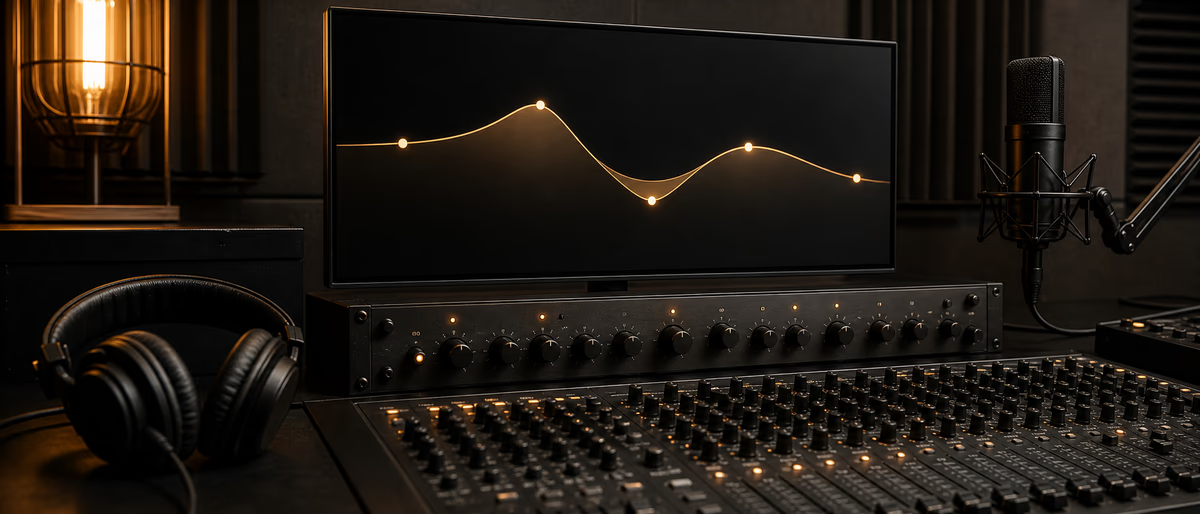
EQ equalization
คำตอบสั้นๆ
EQ (equalization) is a mixing tool that boosts or cuts specific frequency ranges so you can reshape a sound’s tone.[1] Producers use it to remove mud, carve space between instruments, and add clarity or air — with parametric, graphic, shelf, and cut filters across roughly 20 Hz–20 kHz.
What EQ Actually Does
An equalizer (EQ) shapes the tonal character of a sound by boosting or attenuating the level of one or more frequencies.[1] You already use simplified EQ every day: bass and treble knobs on a phone, car stereo, or Bluetooth speaker. Studio EQ is the same idea with surgical control.
At the heart of any EQ is a filter. The filter design decides which range is affected and how steep the change is. Professional EQs expose several filter types so you can clean rumble, fix a boxy vocal, or open air on a master bus without rewriting the arrangement.[1]
In a DAW session, EQ sits on individual tracks, buses, and often the mix bus. It does not fix a broken arrangement by itself — but used after balance and gain staging, it is one of the fastest ways to make a busy beat readable.
Frequency Bands: The Mix Map
Human hearing is commonly described from about 20 Hz to 20 kHz. For mixing, that spectrum is split into named ranges so you can talk about “mud,” “honk,” or “air” without guessing numbers.[2] Boundaries vary slightly between educators, but the practical map below matches widely used production charts.
| Band | Approx. range | What it feels like | Common mix job |
|---|---|---|---|
| Sub-bass | 20–60 Hz | Felt more than heard; rumble and weight | Control 808/kick fundamentals; avoid excess on small speakers[2] |
| Bass | 60–250 Hz | Power, body, boom | Balance kick vs bass; watch for boominess[2] |
| Low mids | 250–500 Hz | Warmth, thickness, mud | Clear clutter when the mix feels “woofy”[2] |
| Mids | 500 Hz–2 kHz | Core note identity, “honk” if overdone | Separate guitars, keys, and lead melodies[2] |
| Upper mids | 2–4 kHz | Presence; ears are very sensitive here | Vocal intelligibility and attack — easy to make harsh[2] |
| Presence / highs | 4–6 kHz+ | Definition, bite, then air/brilliance | Cymbals, sibilance, “air” shelves higher up[2] |
FabFilter’s education material subdivides the spectrum further (for example 20–50 Hz as mostly felt, 1.5–4 kHz as especially present because of ear-canal resonance, and the top end as overtone/air territory).[3] Memorize the map, then always decide by ear in context — not by a fixed “boost 3 kHz on vocals” preset.
Parametric vs Graphic vs Shelf and Cut Filters
Not all EQs expose the same controls. Knowing the families stops you from fighting the wrong tool.
- Parametric (bell) EQ A fully parametric bell typically offers frequency (center), gain (boost/cut amount), and Q (bandwidth). Higher Q = narrower band. This is the workhorse for surgical fixes and musical boosts.[1]
- Graphic EQ Fixed frequency bands (often many sliders) with gain per band and little or no free frequency/Q control. Fast for broad tone shaping and live systems; less precise for hunting a single resonance than a parametric band.
- High-pass / low-cut Always subtractive: removes energy below the cutoff (high-pass lets highs through). Slope is measured in dB per octave. First-choice cleanup for rumble and unused low end.[1]
- Low-pass / high-cut Removes energy above the cutoff. Useful for thinning synths, darkening backgrounds, or creative filter moves.[1]
- Low / high shelf Boosts or cuts everything below (low shelf) or above (high shelf) a corner frequency — the professional version of bass/treble knobs.[1]
- Notch / band-pass Notch digs a narrow hole (feedback, whistle, hard resonance). Band-pass isolates a middle slice — often creative or “radio speaker” effects.[4]
What stock parametric EQs look like in a DAW
Ableton Live’s EQ Eight is a typical modern parametric: up to eight filters per channel, each switchable between low cut, low shelf, peak, notch, high shelf, and high cut (with selectable slopes on the cuts). You can process in Stereo, L/R, or Mid/Side mode and edit frequency, gain, and Q from the display or dials.[5]
FabFilter Pro-Q-class plug-ins expand the same idea with shapes such as Bell, Low/High Shelf, Low/High Cut, Notch, Band Pass, Tilt Shelf, Flat Tilt, and All Pass, plus adjustable slopes.[4] You do not need every shape on day one — start with HPF, a couple of bells, and a high shelf.
How to EQ a Track: A Practical Workflow
FabFilter’s intro to EQ stresses three complementary goals: remove junk, make the part fit the mix, and emphasize useful character — after you already have a sensible level balance and arrangement density under control.[1]
- Balance first, EQ second
Set faders so the part roughly sits before you carve. If volume already works, you need less EQ.[1] - High-pass unused low end
On guitars, vocals, hats, and mid synths, raise a gentle high-pass until the low end thins, then back off slightly so the musical body remains.[1] - Hunt problems with a boost-and-sweep (training mode)
Temporarily boost a medium-Q bell and sweep to hear resonances, then cut the offenders rather than leaving a permanent +6 dB boost. Use solo only to learn the tone — decide final moves in the full mix.[1] - Carve complementary space
If kick and bass fight, cut a little where the other needs to own the range instead of boosting both forever. Complementary cuts beat loudness wars between tracks.[1] - Add character last
Broad shelves for air or body; narrow boosts only when a part still disappears after balance and cleanup. - A/B and match loudness
Bypass the EQ and compare at similar level (use the plug-in’s output gain if needed). Louder almost always sounds “better” — don’t trust a loud bypass comparison.
Where Producers Use EQ Every Day
- Cleanup on every track High-pass non-bass sources; notch harsh resonances; low-pass layers that don’t need full air.
- Kick and bass separation Decide who owns sub vs punch (often different centers in the 50–125 Hz and upper-bass zones) instead of stacking two full-range monsters.[3]
- Vocals Clear low-mid mud, ease harsh upper mids, add a light high shelf for air — then de-ess if sibilance spikes (EQ alone is not always enough).
- Buses and groups Gentle broadband moves on drums, music, or vocal buses glue the stack without over-processing every clip.
- Creative sound design Filter sweeps, band-pass “telephone” effects, and mid/side EQ for width (boost sides carefully so mono stays solid).
- Pre-compression shaping Cutting mud before a compressor can stop it from pumping on junk energy — pair with compression fundamentals rather than stacking more boosts.
For broader mix context (balance, panning, headroom), read mixing fundamentals for music producers. For vocal-specific chains, see how to mix vocals.
Common EQ Mistakes
- EQ’ing only in solo A vocal can sound amazing alone and wrong against the beat. Solo to diagnose; commit while the full mix plays.[1]
- Boosting instead of cutting first Narrow cuts often free space with less harshness than competitive boosts. Boost when something is genuinely missing, not to “win” against another track.
- Ignoring low-mid buildup 250–500 Hz is where many instruments pile up. Too much feels muddy and small-speaker dead; too little feels thin.[2]
- Surgical EQ on every problem If ten tracks need extreme surgery, the arrangement, sample choices, or recording may be the real issue — not a missing Q value.
- Skipping translation checks Sub and low bass are hard to judge on untreated small rooms and limited speakers. Check headphones and another system before locking low-end moves.[3]
Free EQ Plugins Worth Starting With
You do not need a boutique EQ to learn. Start with your DAW’s stock parametric (for example Ableton’s EQ Eight with up to eight bands and standard filter shapes).[5] Then add one free third-party tool if you want a different workflow.
Stock parametric EQ (any DAW)
Learn frequency, gain, and Q on the equalizer that ships with your host. Same concepts transfer to every paid plug-in later.
Price: included with DAW
Best for: daily cleanup and learning
TDR Nova
Tokyo Dawn Labs’ free TDR Nova is a parallel dynamic equalizer with four dynamic EQ bands plus input high-pass/low-pass filtering — useful when a static cut is not enough.[6]
Price: free
Best for: dynamic EQ / problem frequencies
Browse free EQ on Plugg Supply
We catalogue free equalizers and mix tools so you can download verified files without hopping sketchy mirror sites. Pair EQ with free compressors once tone is under control.
Where: /software
Also read: best free EQ plugins guide
For a curated shortlist, open our best free EQ plugins guide, then grab more mix tools from free software on Plugg Supply. When you outgrow free options, pro tools like FabFilter Pro-Q document the same filter vocabulary (bells, shelves, cuts, notch, tilt) at higher band counts and workflow depth.[7]
Download free EQ and mixing plugins — verified files, no junk installers.
Learning path
ฮับคำตอบที่เกี่ยวข้อง
เครื่องมือ
ซอฟต์แวร์และปลั๊กอินสำหรับเวิร์กโฟลว์นี้
ปลั๊กอิน, DAW และเครื่องมือการผลิตที่เชื่อมต่อกับเวิร์กโฟลว์ที่กล่าวถึงในบทความนี้
![Ridge Sound Fold EQ v1.1 [WiN]](/images/posts/ridge-sound-fold-eq-85833.avif?v=2026080101)
![Black Salt Audio Instinct EQ v1.0.0 [WiN]](/images/posts/black-salt-audio-instinct-eq-82709.avif?v=2026080101)
![Final Mix Software EQ-73 MODERN III [WiN]](/images/posts/final-mix-software-eq-73-modern-iii-85352.avif?v=2026080101)
![Final Mix Software MIX BUS EQ III RETAiL [WiN]](/images/posts/final-mix-software-mix-bus-eq-iii-84991.avif?v=2026080101)
คำถามที่พบบ่อย
- What is EQ in music production?
- EQ (equalization) boosts or attenuates chosen frequency ranges to shape a sound’s tone and make parts fit together in a mix.[1]
- What is the difference between parametric and graphic EQ?
- Parametric EQ lets you set frequency, gain, and bandwidth (Q) freely for each band. Graphic EQ uses fixed frequency sliders with gain control — faster for broad curves, less precise for hunting one resonance.[1]
- What does Q mean on an EQ?
- Q controls bandwidth of a bell (or resonance of some filters). Higher Q affects a narrower slice of the spectrum; lower Q is broader and more musical for gentle tone moves.[1]
- Should I cut or boost when EQing?
- Both are valid. Cuts often free space and reduce masking with less harshness; boosts add missing character. Compare at matched loudness so boosts don’t “win” only because they are louder.[1]
- What frequency ranges should I know for mixing?
- A practical map is sub-bass (~20–60 Hz), bass (60–250 Hz), low mids (250–500 Hz), mids (500 Hz–2 kHz), upper mids (2–4 kHz), then presence and brilliance above ~4 kHz.[2]
- What is a high-pass filter vs a low shelf?
- A high-pass (low-cut) removes energy below a cutoff. A low shelf boosts or cuts lows but leaves a flat plateau rather than rolling everything to silence.[1]
- Are free EQ plugins good enough?
- Yes for learning and most home-studio work. Stock DAW EQs and free tools such as TDR Nova cover cleanup, tone, and even dynamic EQ; paid EQs mainly buy workflow, analysis, and deeper feature sets.[6]